LinkedList is a doubly-linked list implementation of the List and Deque interfaces. By “doubly-linked”, it means we can traverse the list from the beginning to the end, and vice versa. This class is a member of Java Collections Framework, located in java.util. Let’s go straight to the source code.
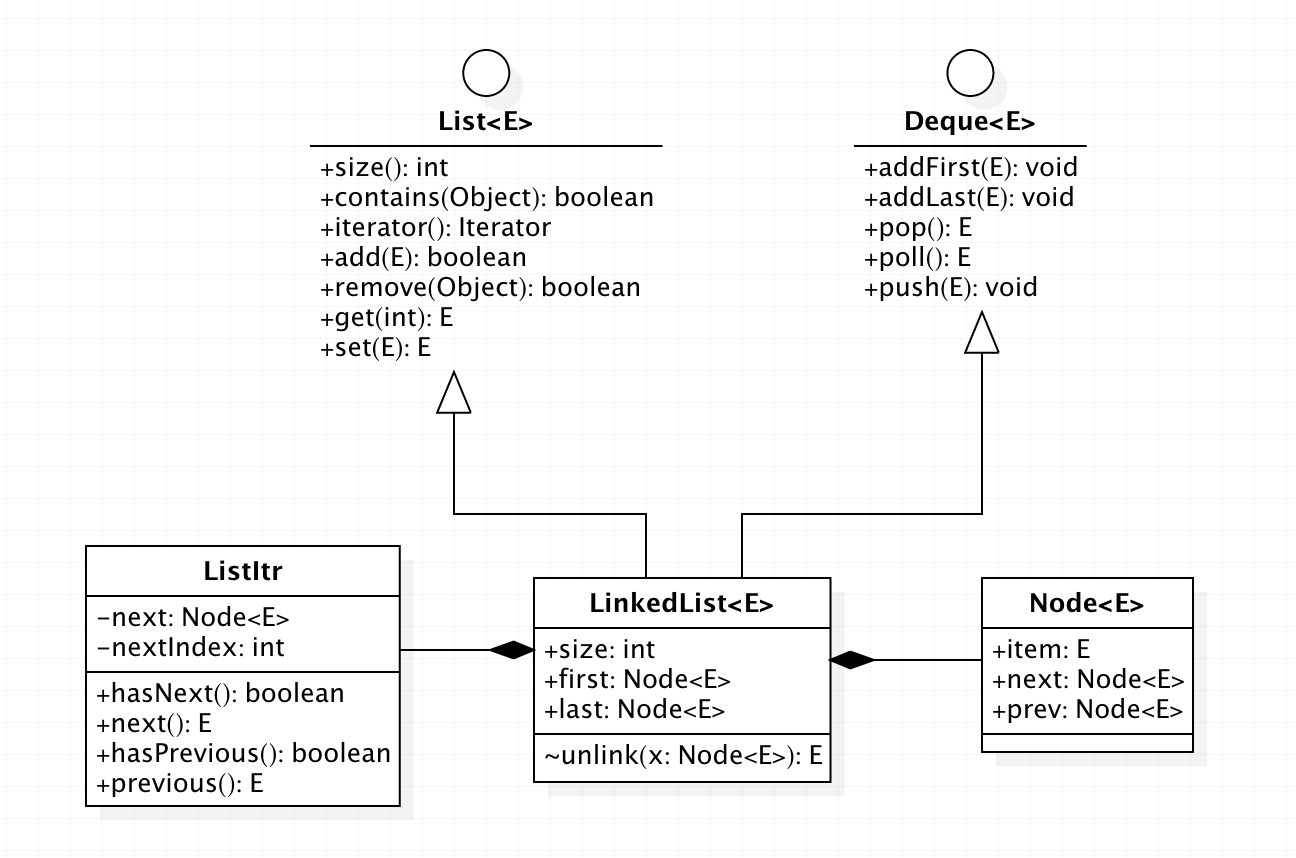
The Class Diagram of LinkedList as follows.
Node
Link to heading
// LinkedList.java
private static class Node<E> {
    E item;
    Node<E> next;
    Node<E> prev;

    Node(Node<E> prev, E element, Node<E> next) {
        this.item = element;
        this.next = next;
        this.prev = prev;
    }
}
Member Variables Link to heading
Three fields in LinkedList includes,
size, the size of this list.first, pointer to first node.last, pointer to last node.
// LinkedList.java

public class LinkedList<E>
    extends AbstractSequentialList<E>
    implements List<E>, Deque<E>, Cloneable, java.io.Serializable
{
    transient int size = 0;
    transient Node<E> first;
    transient Node<E> last;
}
Member Functions Link to heading
Constructor Link to heading
The constructor constructs a list containing the elements of the specified collection.
// LinkedList.java

public LinkedList(Collection<? extends E> c) {
    this();
    addAll(c);
}

public boolean addAll(Collection<? extends E> c) {
    return addAll(size, c);
}

public boolean addAll(int index, Collection<? extends E> c) {
    checkPositionIndex(index);

    Object[] a = c.toArray();
    int numNew = a.length;
    if (numNew == 0)
        return false;

    Node<E> pred, succ;
    if (index == size) {
        succ = null;
        pred = last;
    } else {
        succ = node(index);
        pred = succ.prev;
    }

    for (Object o : a) {
        @SuppressWarnings("unchecked") E e = (E) o;
        Node<E> newNode = new Node<>(pred, e, null);
        if (pred == null)
            first = newNode;
        else
            pred.next = newNode;
        pred = newNode;
    }

    if (succ == null) {
        last = pred;
    } else {
        pred.next = succ;
        succ.prev = pred;
    }

    size += numNew;
    modCount++;
    return true;
}
getFirst & getLast
Link to heading
getFirst returns the first element in this list, thanks to first pointer, which makes this very easy.
// LinkedList.java

public E getFirst() {
    final Node<E> f = first;
    if (f == null)
        throw new NoSuchElementException();
    return f.item;
}

public E getLast() {
    final Node<E> l = last;
    if (l == null)
        throw new NoSuchElementException();
    return l.item;
}
removeFirst & removeLast
Link to heading
removeFirst retrieves and removes the head (first element) of this list, so that pop calls removeFirst directly.
Oppositely, removeLast removes and returns the last element from this list.
// LinkedList.java

public E removeFirst() {
    final Node<E> f = first;
    if (f == null)
        throw new NoSuchElementException();
    return unlinkFirst(f);
}

public E removeLast() {
    final Node<E> l = last;
    if (l == null)
        throw new NoSuchElementException();
    return unlinkLast(l);
}

private E unlinkFirst(Node<E> f) {
    // assert f == first && f != null;
    final E element = f.item;
    final Node<E> next = f.next;
    f.item = null;
    f.next = null; // help GC
    first = next;
    if (next == null)
        last = null;
    else
        next.prev = null;
    size--;
    modCount++;
    return element;
}

private E unlinkLast(Node<E> l) {
    // assert l == last && l != null;
    final E element = l.item;
    final Node<E> prev = l.prev;
    l.item = null;
    l.prev = null; // help GC
    last = prev;
    if (prev == null)
        first = null;
    else
        prev.next = null;
    size--;
    modCount++;
    return element;
}
for unlinkFirst, you must reset the last pointer if needed, and first pointer for unlinkLast.
addFirst & addLast
Link to heading
addFirst inserts the specified element at the beginning of this list.
// LinkedList.java
public void addFirst(E e) {
    linkFirst(e);
}

public void addLast(E e) {
    linkLast(e);
}

private void linkFirst(E e) {
    final Node<E> f = first;
    final Node<E> newNode = new Node<>(null, e, f);
    first = newNode;
    if (f == null)
        last = newNode;
    else
        f.prev = newNode;
    size++;
    modCount++;
}

void linkLast(E e) {
    final Node<E> l = last;
    final Node<E> newNode = new Node<>(l, e, null);
    last = newNode;
    if (l == null)
        first = newNode;
    else
        l.next = newNode;
    size++;
    modCount++;
}
After a new Node is inserted as first node, not only first pointer, but also the last pointer may be changed.
contains & indexOf
Link to heading
contains, turning to indexOf, checks if this list contains the specified element.
// LinkedList.java

public boolean contains(Object o) {
    return indexOf(o) >= 0;
}

public int indexOf(Object o) {
    int index = 0;
    if (o == null) {
        for (Node<E> x = first; x != null; x = x.next) {
            if (x.item == null)
                return index;
            index++;
        }
    } else {
        for (Node<E> x = first; x != null; x = x.next) {
            if (o.equals(x.item))
                return index;
            index++;
        }
    }
    return -1;
}
indexOf iterates all items in the list in consecutive order and examines the equality.
remove
Link to heading
remove removes the first occurrence of the specified element from this list, if it is present.
// LinkedList.java

public boolean remove(Object o) {
    if (o == null) {
        for (Node<E> x = first; x != null; x = x.next) {
            if (x.item == null) {
                unlink(x);
                return true;
            }
        }
    } else {
        for (Node<E> x = first; x != null; x = x.next) {
            if (o.equals(x.item)) {
                unlink(x);
                return true;
            }
        }
    }
    return false;
}

E unlink(Node<E> x) {
    // assert x != null;
    final E element = x.item;
    final Node<E> next = x.next;
    final Node<E> prev = x.prev;

    if (prev == null) {
        first = next;
    } else {
        prev.next = next;
        x.prev = null;
    }

    if (next == null) {
        last = prev;
    } else {
        next.prev = prev;
        x.next = null;
    }

    x.item = null;
    size--;
    modCount++;
    return element;
}
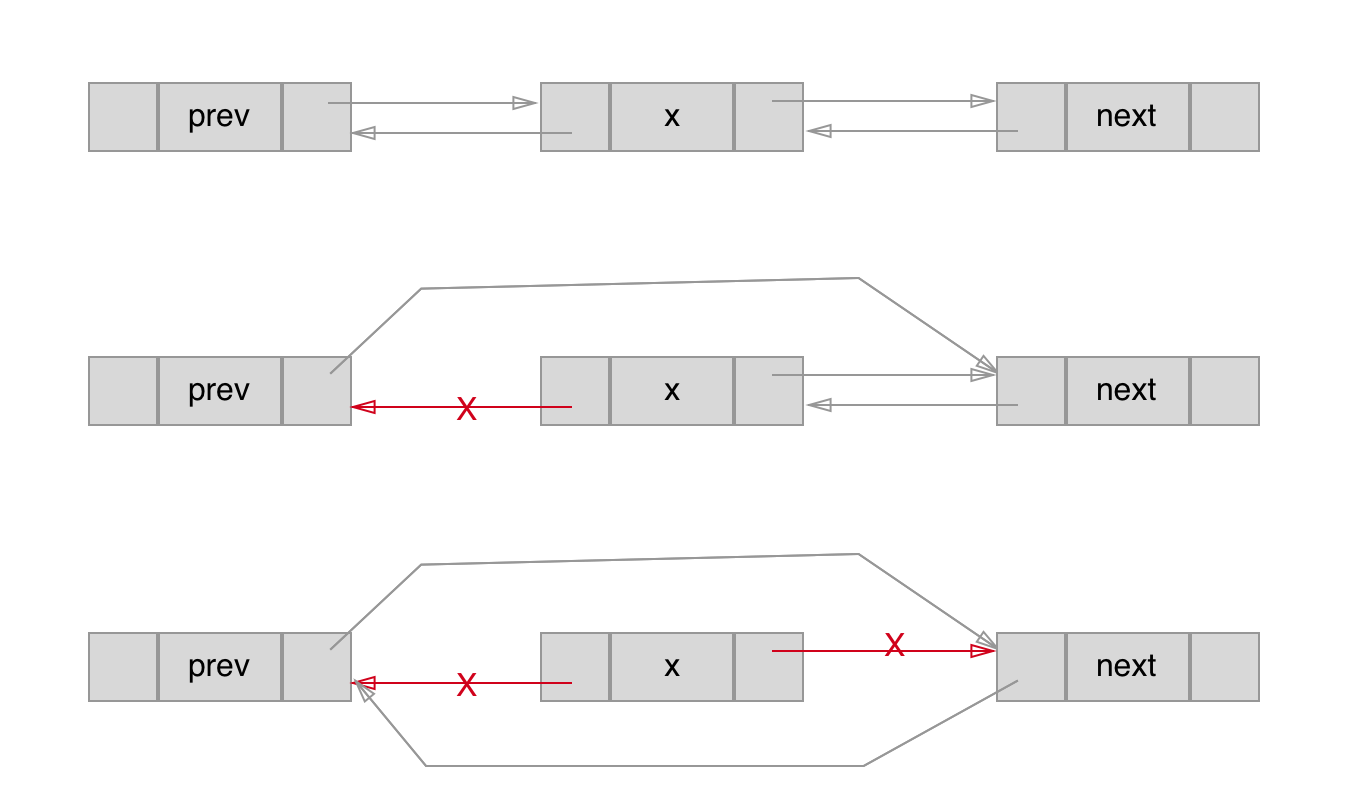
The steps of unlink lists,
get & set
Link to heading
get and set both call node to fetch the node at the specified element index.
public E get(int index) {
    checkElementIndex(index);
    return node(index).item;
}

public E set(int index, E element) {
    checkElementIndex(index);
    Node<E> x = node(index);
    E oldVal = x.item;
    x.item = element;
    return oldVal;
}

Node<E> node(int index) {
    // assert isElementIndex(index);

    if (index < (size >> 1)) {
        Node<E> x = first;
        for (int i = 0; i < index; i++)
            x = x.next;
        return x;
    } else {
        Node<E> x = last;
        for (int i = size - 1; i > index; i--)
            x = x.prev;
        return x;
    }
}
node(int) first checks the element locates in which half of list to determine which end to start iterating.