After joining the workforce, I have coded with various programming languages, like C++, Objective-C, Ruby, Python, Scala, Java, Go, etc. I ask to myself spontaneously, which language am I most skillful at? This question dismay me because I cannot answer it immediately.
Since I choice to focus on Big Data, it’s pragmatic to equipped with Java and Python, two powerful weapons in this field. Reading the source code of java.util is a good start.
The leading actor of this post is TreeMap, a Red-Black tree based NavigableMap implementation. It has no array underneath, as many of you think. Because TreeMap inherits directly AbstractMap, in contrast with LinkedHashMap.
Performances differ on account of distinctive data structures. This implementation provides guaranteed log(n) time cost for the containsKey, get, put and remove operations. Now allow me to show you a close look.
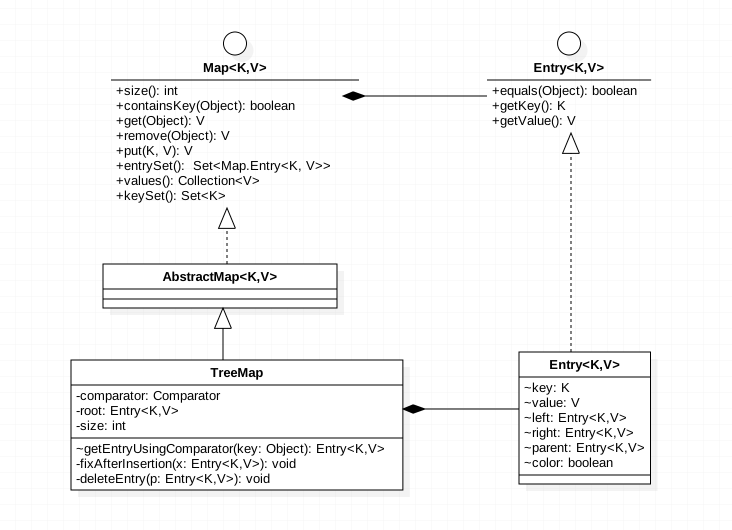
Member Variables Link to heading
// TreeMap.java

public class TreeMap<K,V>
    extends AbstractMap<K,V>
    implements NavigableMap<K,V>, Cloneable, java.io.Serializable
{
    private static final boolean RED   = false;
    private static final boolean BLACK = true;

    private final Comparator<? super K> comparator;

    private transient Entry<K,V> root;

    private transient int size = 0;
}
Two variables RED and BLACK hints that TreeMap relies on Red-Black tree to store key-value pairs.
comparator is used to maintain order in this tree map, which can be null if it uses the natural ordering of its keys.
Node in the tree is represented by Entry, an implementation of Map.Entry.
// TreeMap.java

static final class Entry<K,V> implements Map.Entry<K,V> {
    K key;
    V value;
    Entry<K,V> left;
    Entry<K,V> right;
    Entry<K,V> parent;
    boolean color = BLACK;
}
Other than normal binary tree, the node in Red-Black tree has parent referring to its parent. We will find its usage in the following section.
get
Link to heading
get returns the value to which the specified key is mapped.
// TreeMap.java

public V get(Object key) {
    Entry<K,V> p = getEntry(key);
    return (p==null ? null : p.value);
}

final Entry<K,V> getEntry(Object key) {
    // Offload comparator-based version for sake of performance
    if (comparator != null)
        return getEntryUsingComparator(key);
    if (key == null)
        throw new NullPointerException();
    @SuppressWarnings("unchecked")
        Comparable<? super K> k = (Comparable<? super K>) key;
    Entry<K,V> p = root;
    while (p != null) {
        int cmp = k.compareTo(p.key);
        if (cmp < 0)
            p = p.left;
        else if (cmp > 0)
            p = p.right;
        else
            return p;
    }
    return null;
}
Assume this map has its own comparator so that we can examine what getEntryUsingComparator does.
// TreeMap.java

final Entry<K,V> getEntryUsingComparator(Object key) {
    @SuppressWarnings("unchecked")
        K k = (K) key;
    Comparator<? super K> cpr = comparator;
    if (cpr != null) {
        Entry<K,V> p = root;
        while (p != null) {
            int cmp = cpr.compare(k, p.key);
            if (cmp < 0)
                p = p.left;
            else if (cmp > 0)
                p = p.right;
            else
                return p;
        }
    }
    return null;
}
As we can see, it’s a typical pre-order traversal of binary tree, a binary search tree particularly. Time complexity of log(n) is inevitable involving iteration of a tree.
Then how is this tree built?
put
Link to heading
put associates the specified value with the specified key in this map. If the map previously contained a mapping for the key, the old value is replaced.
// TreeMap.java

public V put(K key, V value) {
    Entry<K,V> t = root;
    if (t == null) {
        compare(key, key); // type (and possibly null) check

        root = new Entry<>(key, value, null);
        size = 1;
        modCount++;
        return null;
    }
    int cmp;
    Entry<K,V> parent;
    // split comparator and comparable paths
    Comparator<? super K> cpr = comparator;
    if (cpr != null) {
        do {
            parent = t;
            cmp = cpr.compare(key, t.key);
            if (cmp < 0)
                t = t.left;
            else if (cmp > 0)
                t = t.right;
            else
                return t.setValue(value);
        } while (t != null);
    }
    else {
        if (key == null)
            throw new NullPointerException();
        @SuppressWarnings("unchecked")
            Comparable<? super K> k = (Comparable<? super K>) key;
        do {
            parent = t;
            cmp = k.compareTo(t.key);
            if (cmp < 0)
                t = t.left;
            else if (cmp > 0)
                t = t.right;
            else
                return t.setValue(value);
        } while (t != null);
    }
    Entry<K,V> e = new Entry<>(key, value, parent);
    if (cmp < 0)
        parent.left = e;
    else
        parent.right = e;
    fixAfterInsertion(e);
    size++;
    modCount++;
    return null;
}
Firstly, find the parent of new node by pre-order traversal. After inserting new entry, fixAfterInsertion is invoked to rotate the tree for rebalance.
// TreeMap.java

private void fixAfterInsertion(Entry<K,V> x) {
    x.color = RED;

    while (x != null && x != root && x.parent.color == RED) {
        if (parentOf(x) == leftOf(parentOf(parentOf(x)))) {
            Entry<K,V> y = rightOf(parentOf(parentOf(x)));
            if (colorOf(y) == RED) {
                setColor(parentOf(x), BLACK);
                setColor(y, BLACK);
                setColor(parentOf(parentOf(x)), RED);
                x = parentOf(parentOf(x));
            } else {
                if (x == rightOf(parentOf(x))) {
                    x = parentOf(x);
                    rotateLeft(x);
                }
                setColor(parentOf(x), BLACK);
                setColor(parentOf(parentOf(x)), RED);
                rotateRight(parentOf(parentOf(x)));
            }
        } else {
            Entry<K,V> y = leftOf(parentOf(parentOf(x)));
            if (colorOf(y) == RED) {
                setColor(parentOf(x), BLACK);
                setColor(y, BLACK);
                setColor(parentOf(parentOf(x)), RED);
                x = parentOf(parentOf(x));
            } else {
                if (x == leftOf(parentOf(x))) {
                    x = parentOf(x);
                    rotateRight(x);
                }
                setColor(parentOf(x), BLACK);
                setColor(parentOf(parentOf(x)), RED);
                rotateLeft(parentOf(parentOf(x)));
            }
        }
    }
    root.color = BLACK;
}
parent is essential when rotation happens. See C Program for Red Black Tree Insertion if you find it’s hard to understand this rebalance.
remove
Link to heading
It’s reasonable to presume that removing a node would also trigger rotation of the tree. So it does.
// TreeMap.java

public V remove(Object key) {
    Entry<K,V> p = getEntry(key);
    if (p == null)
        return null;

    V oldValue = p.value;
    deleteEntry(p);
    return oldValue;
}

private void deleteEntry(Entry<K,V> p) {
    modCount++;
    size--;

    // If strictly internal, copy successor's element to p and then make p
    // point to successor.
    if (p.left != null && p.right != null) {
        Entry<K,V> s = successor(p);
        p.key = s.key;
        p.value = s.value;
        p = s;
    } // p has 2 children

    // Start fixup at replacement node, if it exists.
    Entry<K,V> replacement = (p.left != null ? p.left : p.right);

    if (replacement != null) {
        // Link replacement to parent
        replacement.parent = p.parent;
        if (p.parent == null)
            root = replacement;
        else if (p == p.parent.left)
            p.parent.left  = replacement;
        else
            p.parent.right = replacement;

        // Null out links so they are OK to use by fixAfterDeletion.
        p.left = p.right = p.parent = null;

        // Fix replacement
        if (p.color == BLACK)
            fixAfterDeletion(replacement);
    } else if (p.parent == null) { // return if we are the only node.
        root = null;
    } else { //  No children. Use self as phantom replacement and unlink.
        if (p.color == BLACK)
            fixAfterDeletion(p);

        if (p.parent != null) {
            if (p == p.parent.left)
                p.parent.left = null;
            else if (p == p.parent.right)
                p.parent.right = null;
            p.parent = null;
        }
    }
}